

Habit stacking is a strategic method that enhances motivation by connecting new behaviors to established habits, making them more automatic. The technique leverages environmental cues and behavioral triggers to ease the transition and ensure consistent practice. By aligning the timing of new habits with existing routines and creating positive emotional associations, habit stacking strengthens neural pathways and increases adherence. Effective anchor habits, which are deeply ingrained, serve as reliable triggers, integrating seamlessly with new actions. This approach not only fosters time management and productivity but also supports sustainable lifestyle changes and goal achievement. Discover the transformative potential of habit stacking in the details.
Key Takeaways
- Habit stacking connects new behaviors to existing habits, making actions more automatic.
- Environmental and timing cues help trigger and reinforce new habits.
- Positive reinforcement and emotional associations increase the likelihood of habit formation.
- Effective anchor habits should align with personal goals and require minimal effort.
- Consistent practice and accountability support long-term maintenance of new habits.
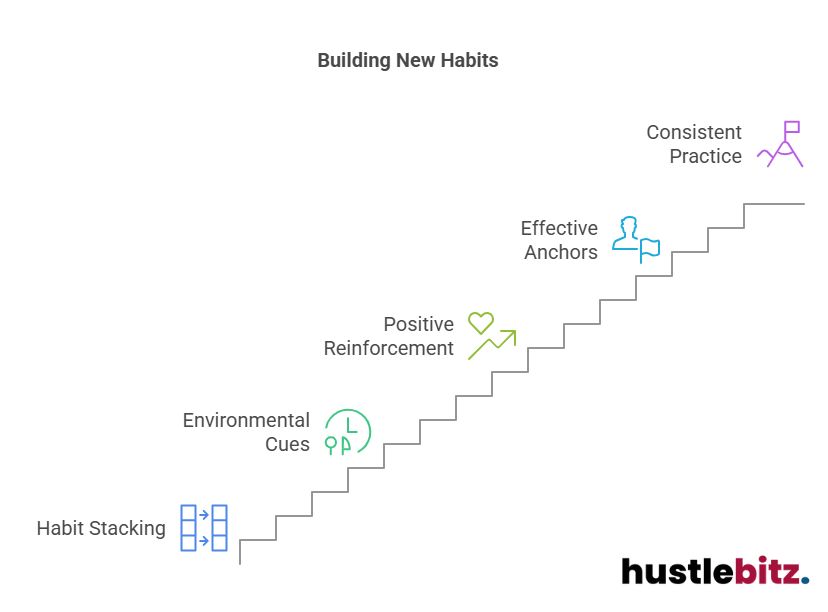
Understanding Habit Stacking
Habit stacking is a powerful technique that involves linking new behaviors to existing habits, creating a chain of actions that become more automatic over time. This method leverages the consistency of established routines to introduce additional positive behaviors, ensuring a smoother integration into daily life.
To effectively implement habit stacking, one must first consider habit compatibility. This refers to the alignment between the new behavior and the existing habit. For instance, if you already have a habit of making coffee every morning, you might add a new habit of drinking a glass of water while the coffee brews. This seamless pairing increases the likelihood of adherence.
Cue identification is another critical element. Cues are specific triggers that prompt you to initiate a behavior. By identifying clear, consistent cues within your existing habits, you can strategically attach new behaviors. For example, the sound of the coffee machine starting can serve as a cue to drink water, making the transition to the new habit almost effortless.
Timing strategies are also essential for habit stacking. Aligning the timing of the new behavior with the existing habit ensures consistency. If your morning routine already includes coffee at 7 AM, adding your new habit at this exact time capitalizes on the predictability of your schedule.
Environmental triggers play a pivotal role in habit stacking. By structuring your environment to support new behaviors, you reinforce the habit loop. Placing a water bottle next to your coffee maker, for example, ensures that the new habit is visually and physically linked to the existing one.
Lastly, incorporating reward systems can significantly enhance motivation. By rewarding yourself for successfully completing the new habit, you create positive associations that encourage continued practice. This could be as simple as enjoying a brief moment of relaxation after completing your stacked habits, reinforcing the routine’s benefits.
The Psychology Behind Habits

Understanding the psychology behind habits reveals why certain behaviors become ingrained over time and others fall by the wayside. Central to this understanding is the concept of behavior reinforcement, where actions that yield positive outcomes are repeated and thus become habits. Conversely, behaviors that lead to negative consequences are less likely to be repeated, reducing their likelihood of becoming habitual.
Neural pathways play a crucial role in habit formation. When a behavior is repeated, specific neural pathways in the brain are strengthened, making the behavior easier and more automatic over time. This neurological basis explains why habits, both good and bad, can become deeply entrenched.
Environmental triggers are another key factor. These triggers, which can include specific locations, times of day, or social contexts, serve as cues that prompt habitual behaviors. For example, walking into the kitchen might trigger the habit of making a cup of coffee. Recognizing these triggers can be essential for both forming new habits and breaking old ones.
Emotional associations also significantly impact habit formation. Behaviors tied to positive emotions are more likely to become habitual. For instance, if exercising makes you feel good, you are more likely to repeat it. Conversely, if a behavior is associated with negative emotions, it is less likely to become a habit.
Benefits of Habit Stacking
Incorporating the technique of habit stacking into daily routines offers numerous advantages that can lead to significant improvements in productivity and well-being. By linking new behaviors to established habits, individuals can create seamless transitions, fostering a more efficient use of time and resources. One of the key benefits is enhanced time management. Habit stacking allows individuals to accomplish multiple tasks within a designated period, thus optimizing their schedules and reducing the mental load associated with planning and prioritization.
Moreover, habit stacking can result in a substantial productivity boost. By strategically aligning tasks that complement each other, individuals can maintain momentum and reduce downtime. This efficient approach not only maximizes output but also promotes a sense of accomplishment, which can be highly motivating.
| Benefit | Description | Example |
| Time Management | Efficiently using time to complete related tasks | Drinking water while reading emails |
| Productivity Boost | Reducing downtime and maintaining momentum | Exercising while listening to audiobooks |
| Lifestyle Changes | Facilitating the adoption of new, healthier habits | Meditating after brushing teeth |
| Goal Setting | Structuring actions to achieve long-term goals | Writing a journal entry before bedtime |
In addition to time management and productivity, habit stacking supports significant lifestyle changes. By embedding new behaviors into existing routines, individuals can gradually incorporate healthier habits without overwhelming themselves. This method of behavior modification helps in creating sustainable changes that align with personal and professional goals.
How Habits Form

Forming a new habit involves a complex interplay of neurological, psychological, and environmental factors. At the heart of habit formation lies the “habit loop,” a three-step process consisting of a cue, routine, and reward. The cue is a trigger that initiates the behavior, the routine is the behavior itself, and the reward is the positive reinforcement that solidifies the behavior in our minds. This cue-routine-reward cycle strengthens over time, establishing a robust cue routine connection within our neurological pathways.
Neurological pathways play a crucial role in habit formation. As behaviors are repeated, the brain forms new synaptic connections that make the routine more automatic. This process, known as “neuroplasticity,” allows the brain to adapt and prioritize frequently performed actions, thereby reducing cognitive load. The more these pathways are used, the stronger they become, making the habit increasingly ingrained.
Environmental triggers also significantly influence habit formation. Our surroundings can provide cues that prompt certain behaviors. For instance, seeing a gym bag by the door may trigger the routine of going for a workout. By strategically placing environmental triggers, individuals can enhance the likelihood of engaging in desired behaviors, thereby facilitating the formation of new habits.
Behavioral reinforcement is another critical element. Positive reinforcement, such as rewards or self-praise, can make the habit loop more appealing and increase the likelihood of repeating the behavior. Conversely, negative reinforcement or punishment can weaken the habit loop, making the behavior less likely to recur.
Understanding these elements—neurological pathways, habit loops, environmental triggers, and behavioral reinforcement—provides valuable insights into how habits form and offers practical strategies for developing new, beneficial behaviors.
Choosing Anchor Habits

Selecting effective anchor habits is a crucial step in the process of habit stacking. Anchor habits, or existing routines that serve as triggers for new behaviors, provide the foundation upon which additional habits can be built. Identifying personal routines that naturally fit into one’s daily life is essential to ensure seamless integration. This involves a thorough assessment of current activities, pinpointing those that occur consistently and without much effort.
When selecting effective anchors, it is important to align these routines with overarching personal or professional goals. This alignment ensures that the new habits contribute meaningfully to desired outcomes, thereby enhancing motivation. For instance, if the goal is to improve physical health, anchoring a new habit like a morning walk to an existing habit such as brushing teeth can be highly effective.
Assessing habit compatibility is another critical factor in choosing anchor habits. Not all routines will serve as suitable anchors for every new behavior. The compatibility of the new habit with the existing routine must be evaluated to ensure that the combination is logical and manageable. For example, stacking the habit of reading a book onto the routine of morning coffee can be compatible because both activities naturally complement a calm start to the day.
Overcoming resistance is an inevitable part of the process. New habits often face initial resistance due to the discomfort of change. Selecting anchor habits that are deeply ingrained and require minimal conscious effort can help mitigate this resistance. By leveraging these well-established routines, the transition to incorporating new behaviors becomes smoother and more sustainable.
This strategic approach to selecting anchor habits sets the foundation for successful habit stacking and long-term behavioral change.
Creating Motivation Through Habit Stack

Building on the foundation of selecting effective anchor habits, the next step involves generating motivation through the strategic use of habit stacking. By leveraging motivational triggers and behavioral cues, individuals can seamlessly integrate new habits into their existing routines. This method hinges on the principle that linking a new behavior to an established one creates a smooth transition, making it easier to adapt and maintain consistency.
One critical aspect of creating motivation through habit stacking is the application of incremental changes. Rather than attempting to overhaul one’s routine entirely, small, manageable adjustments are made, which gradually build up to significant behavioral transformations. These incremental changes prevent overwhelm and promote sustained effort, ensuring long-term success.
Routine reinforcement is another pivotal element in this process. By consistently performing the new habit after the anchor habit, individuals reinforce the behavior until it becomes second nature. This repetition solidifies the new habit within the framework of the existing routine, making it more resilient to disruptions.
Accountability partners can further enhance motivation during habit stacking. Having someone to share progress with or to check in regularly provides an additional layer of support and encouragement. This social aspect can be a powerful motivational trigger, as the desire to meet expectations and avoid letting down a partner fosters commitment.
Ultimately, the synergy created by combining motivational triggers, behavioral cues, incremental changes, routine reinforcement, and accountability partners forms a robust framework for habit stacking. This comprehensive approach not only aids in the establishment of new habits but also ensures they are maintained effectively over time.
Examples of Habit Stacking

When it comes to illustrating the practical application of habit stacking, numerous real-world examples demonstrate its effectiveness in fostering positive behavioral changes. This technique involves linking new habits to already established behaviors, making it easier to incorporate additional positive actions into daily life. Below are several examples that highlight how habit stacking can enhance morning routines, productivity hacks, fitness goals, daily rituals, and mindfulness practices.
Examples of Habit Stacking:
| Situation | Established Habit | New Habit |
| Morning Routine | Drinking coffee | Reviewing daily goals |
| Productivity Hacks | Checking emails | Decluttering workspace |
| Fitness Goals | Brushing teeth | Doing a 5-minute stretch |
| Daily Rituals | Walking the dog | Listening to an educational podcast |
| Mindfulness Practices | Sitting down for breakfast | Practicing 2 minutes of gratitude |
In morning routines, for example, pairing the act of drinking coffee with reviewing daily goals transforms a simple ritual into a productivity enhancer. Similarly, linking checking emails with decluttering the workspace not only optimizes productivity hacks but also creates a more organized environment, conducive to focused work.
For those aiming to achieve fitness goals, a productive habit stack could involve performing a 5-minute stretch immediately after brushing teeth, thereby integrating physical activity into the start of the day. Daily rituals such as walking the dog can be paired with listening to an educational podcast, thereby combining physical movement with intellectual growth.
Mindfulness practices can also benefit from habit stacking. For instance, incorporating a 2-minute gratitude practice while sitting down for breakfast can set a positive tone for the day. These examples demonstrate the versatility and effectiveness of habit stacking in seamlessly integrating new, beneficial behaviors into existing routines.
Final Thoughts
Habit stacking is an effective technique for incorporating new habits into your routine by linking them to existing ones. By aligning new behaviors with established habits, using environmental cues, and reinforcing them through consistency and rewards, habit stacking makes it easier to form sustainable, positive habits. With the right anchor habits and gradual changes, this method helps improve productivity, time management, and overall well-being, allowing you to achieve long-term goals with minimal effort.