

Cultivating a growth mindset involves perceiving challenges as opportunities for development, inspired by the wisdom of notable figures. Walt Disney celebrates taking on the impossible with joy, while Ralph Waldo Emerson encourages confronting fears to unlock personal growth. Michael Jordan warns against allowing failure to become habitual, emphasizing perseverance. Stephen Curry redefines success as a deliberate journey rather than mere luck. Voltaire stresses the role of persistent thinking in problem-solving, aligning with Theodore Roosevelt’s encouragement to attempt, despite risks. Einstein and Confucius remind us of persistence’s value, reinforcing that a proactive approach is the cornerstone of progress. Explore further insights to deepen understanding.
Key Takeaways
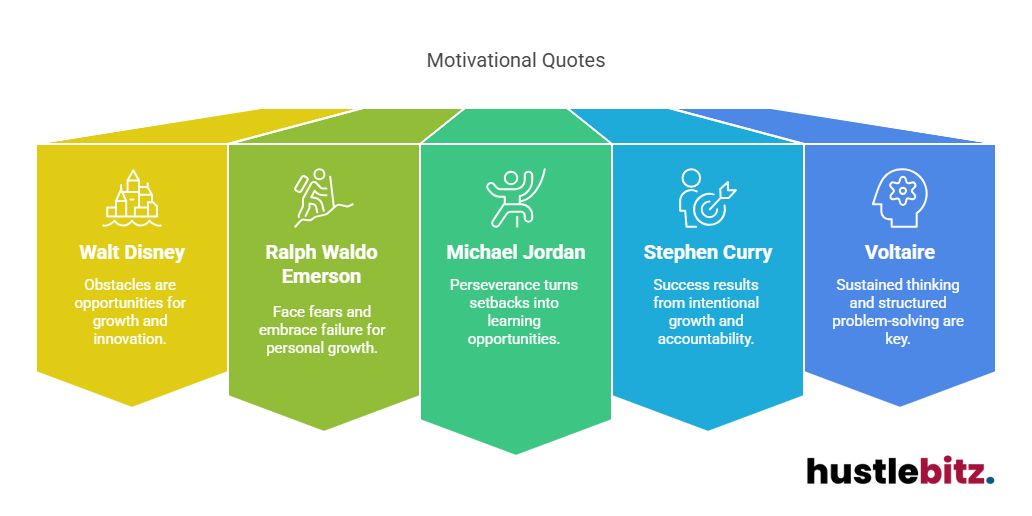
- Walt Disney’s quote inspires imagination and innovation by viewing obstacles as opportunities for growth and creative problem-solving.
- Ralph Waldo Emerson emphasizes facing fears and embracing failure as transformative experiences leading to personal growth and resilience.
- Michael Jordan highlights perseverance’s importance, turning setbacks into learning opportunities and recognizing obstacles as stepping stones.
- Stephen Curry asserts success results from intentional growth and personal accountability, transforming challenges into achievements through deliberate actions.
- Voltaire’s quote stresses the importance of sustained thinking and structured problem-solving to view challenges from multiple perspectives.
“It’s kind of fun to do the impossible.” – Walt Disney

Walt Disney’s quote, “It’s kind of fun to do the impossible,” encapsulates the essence of a growth mindset by emphasizing the joy found in overcoming challenges deemed unattainable. This perspective is crucial for fostering imagination and innovation, as it encourages individuals to venture beyond conventional boundaries. By embracing the seemingly impossible, one unlocks a realm of creative problem solving, where novel solutions emerge from the willingness to tackle daunting tasks.
Disney’s insight highlights the importance of overcoming obstacles, not just for personal growth, but also for driving progress in various fields. This mindset is particularly valuable in environments that require visionary leadership. Leaders who cultivate a growth mindset inspire their teams to view obstacles as opportunities for learning and development.
They encourage embracing uncertainty, understanding that ambiguity can be a catalyst for groundbreaking ideas. Such leaders recognize that innovation often arises from the interplay between imagination and the challenge of the unknown. By fostering a culture that values these principles, they create an environment where creativity thrives, and seemingly insurmountable problems become stepping stones to success.
Incorporating this approach into everyday practice means shifting focus from the fear of failure to the potential for discovery. It involves nurturing a mindset where the excitement of attempting the impossible outweighs the apprehension of uncertainty.
“Always do what you are afraid of doing.” – Ralph Waldo Emerson
Although fear often serves as a natural barrier to action, Ralph Waldo Emerson’s quote, “Always do what you are afraid of doing,” underscores the transformative power of confronting one’s fears. Fear challenges individuals by presenting an opportunity to transcend personal limitations and embark on a journey of self-discovery. Embracing discomfort, therefore, becomes an essential step in the path of personal growth and development.
By intentionally stepping into situations that provoke fear, individuals cultivate courage and resilience, enhancing their capacity to navigate life’s uncertainties.
Courage development is not an innate trait but rather a skill honed through repeated exposure to fear-inducing scenarios. When individuals take calculated risks, they not only defy their apprehensions but also unlock the potential for personal and professional growth. The benefits of risk-taking extend beyond immediate gains, fostering an enduring sense of confidence and self-efficacy.
This shift in perspective encourages individuals to see obstacles not as insurmountable barriers but as stepping stones toward greater achievements.
Overcoming limitations involves recognizing that fear is often a construct of the mind, a protective mechanism that can inadvertently stifle progress. By confronting fears, individuals dismantle these mental barriers, revealing new possibilities and avenues for success.
The courage to act in the face of fear is a testament to the power of the human spirit, illustrating that growth occurs in moments of vulnerability and uncertainty. Ultimately, Emerson’s wisdom invites us to perceive fear not as an enemy but as a catalyst for transformation and empowerment.
“If you quit once it becomes a habit. Don’t Quit.” – Michael Jordan
Building on the idea of confronting fears to foster growth, Michael Jordan’s assertion, “If you quit once it becomes a habit,” emphasizes the profound impact of resilience building on personal development. Jordan, an iconic figure in sports, underscores a critical principle: habit formation.
By quitting, individuals inadvertently lay the groundwork for a pattern of avoidance, which can hinder growth and success. This habitual retreat from challenges not only stifles potential but also erodes the ability to overcome obstacles.
To combat this, employing perseverance techniques becomes essential. These techniques include setting incremental goals that gradually build confidence and resilience. By breaking down daunting tasks into manageable steps, individuals can celebrate small victories, reinforcing a positive cycle of persistence.
This strategy not only aids in overcoming immediate challenges but also strengthens the mindset required to tackle future hurdles.
Mindset strategies play a pivotal role in reshaping how challenges are perceived. Adopting a growth mindset, where failures are seen as learning opportunities, can transform the way obstacles are approached.
This perspective encourages individuals to view setbacks not as insurmountable barriers but as stepping stones to success. By cultivating such a mindset, one can effectively counteract the impulse to quit and instead persevere through adversity.
“Success is not an accident, success is a choice.” – Stephen Curry

Why is success often perceived as a matter of luck or circumstance? This perception is pervasive because many attribute achievements to external factors, neglecting the crucial role of a success mindset and personal accountability. Stephen Curry’s assertion that “Success is not an accident, success is a choice” challenges this notion, emphasizing that success stems from deliberate actions and decisions rather than mere happenstance.
Adopting a success mindset involves committing to intentional growth—actively seeking opportunities to develop skills and knowledge. This proactive approach requires setting clear goals and consistently working towards them, reflecting the idea that success is a series of choices made with purpose.
Personal accountability plays a pivotal role in this process, as individuals must own their actions, learn from missteps, and continuously adjust their paths toward success. Perseverance strategies are essential in transforming challenges into stepping stones. These strategies include maintaining resilience in the face of adversity and viewing setbacks as valuable failure lessons.
Such lessons are not merely mistakes but rather insights that illuminate areas for improvement, further fueling intentional growth. By embracing these insights, individuals reinforce the notion that success is achieved through a series of informed choices and relentless effort.
Ultimately, Stephen Curry’s perspective encourages a shift from attributing success to luck to recognizing it as the result of deliberate choices. This understanding empowers individuals to take control of their destinies, fostering a culture of growth and resilience.
“No problem can withstand the assault of sustained thinking.” – Voltaire

Stephen Curry’s assertion about success being a choice lays the groundwork for understanding the power of persistent, strategic thought. Voltaire’s insight, “No problem can withstand the assault of sustained thinking,” emphasizes that problem solving techniques, when applied consistently, can overcome the most daunting challenges. This philosophy underscores the importance of resilience development and mental fortitude in tackling obstacles.
Critical thinking is paramount in this process. By evaluating problems from multiple perspectives, individuals can identify weaknesses and opportunities within complex issues. Developing a structured approach to problem solving involves several steps:
- Define the Problem Clearly: Precise problem identification is crucial. Without clarity, sustained thinking may veer off course, wasting valuable time and resources.
- Generate Creative Solutions: Encouraging diverse ideas can lead to innovative solutions. Creative problem solving often involves thinking outside conventional boundaries, fostering novel approaches.
- Evaluate and Refine Solutions: Continuous assessment ensures that strategies remain relevant and effective. This iterative process strengthens mental fortitude and adaptability.
By adopting these techniques, one cultivates resilience development—the ability to recover and learn from setbacks. The commitment to sustained thinking fosters a mindset where challenges are perceived not as insurmountable barriers but as opportunities for growth.
This perspective aligns with the growth mindset, which views intelligence and abilities as qualities that can be developed through dedication and effort.
Ultimately, Voltaire’s assertion serves as a reminder that with persistence, strategic thinking, and a willingness to embrace challenges, any problem can be surmounted. This approach not only resolves issues but also contributes to personal and professional growth.
“It is hard to fail but it is worse never to have tried to succeed.” – Theodore Roosevelt

Failure, while daunting, serves as a critical element in the journey toward success, as articulated by Theodore Roosevelt‘s insight, “It is hard to fail but it is worse never to have tried to succeed.” This perspective highlights the inherent value of embracing risk and taking decisive action despite the potential for setbacks.
The willingness to engage with risk taking is fundamental to growth. Without stepping into the unknown, individuals may never uncover their true potential or redefine their success definitions.
The benefits of failure extend beyond mere lessons; they cultivate resilience and a trial mindset. By experiencing failure, individuals learn to adapt and innovate, honing their skills and approaches. This iterative process is crucial, as it enables one to refine strategies and improve upon past attempts.
The importance of perseverance becomes evident in this context, as success is often a culmination of repeated efforts and unwavering determination.
Adopting a trial mindset encourages individuals to view challenges as opportunities for learning rather than insurmountable obstacles. This shift in perspective allows for greater creativity and problem-solving, ultimately leading to more robust solutions and achievements.
By reframing failure as a stepping stone rather than a terminal point, individuals can maintain focus on long-term goals.
In essence, Roosevelt’s quote serves as a powerful reminder that the fear of failure should not deter action. Instead, embracing the potential for failure and recognizing its benefits equips individuals with the tools needed to persevere and redefine their own success definitions.
Through risk taking and resilience, growth becomes an attainable reality.
“It’s not that I’m so smart. It’s just that I stay with problems longer.” – Albert Einstein

Albert Einstein’s assertion, “It’s not that I’m so smart. It’s just that I stay with problems longer,” underscores the profound importance of perseverance in problem-solving. This statement illustrates that intelligence alone is not the sole determinant of success; rather, the ability to persist through difficulties and maintain focus is equally, if not more, crucial.
Embracing challenges as opportunities for growth requires a mindset shift that values resilience and tenacity. Incorporating effective problem-solving strategies involves recognizing that obstacles are not insurmountable but rather stepping stones to deeper understanding.
Here are three key elements to consider when cultivating perseverance techniques:
- Embrace the Process: Understand that the journey towards solving a problem is as significant as the solution itself. Embracing the process involves appreciating the learning and growth that occur along the way.
- Adopt a Growth Mindset: Shifting your mindset to view challenges as opportunities for development can transform how you approach obstacles. A growth mindset encourages learning from failures and persisting despite setbacks.
- Develop Resilience: Building resilience involves strengthening your capacity to recover from difficulties. It enables you to stay committed to your goals and continue working towards solutions, even when progress seems slow.
Einstein’s insight is a reminder that overcoming obstacles requires more than innate ability; it demands dedication and a willingness to persist.
“It does not matter how slowly you go so long as you do not stop.” – Confucius

Confucius’ wisdom, encapsulated in the phrase “It does not matter how slowly you go so long as you do not stop,” highlights the enduring significance of perseverance in achieving success. This timeless insight emphasizes that progress, regardless of its pace, is integral to personal growth and development. It encourages individuals to employ perseverance strategies that embrace continuous learning and adaptation.
The journey toward any goal is often fraught with obstacles, yet the key lies in steadfastly advancing, even if at a slow pace.
Perseverance strategies involve setting incremental goals that cater to one’s capacity for growth, allowing for steady advancement without overwhelming stress. This approach facilitates overcoming obstacles by breaking them into manageable tasks, thus fostering a sense of achievement and motivating further progress.
Continuous learning is crucial in this context, as it equips individuals with the knowledge and skills needed to navigate challenges effectively. By remaining open to new experiences and insights, one can adapt strategies and improve performance over time.
Embracing discomfort is another vital component of this mindset. Growth often occurs outside one’s comfort zone, requiring the individual to face uncertainties and challenges head-on.
Final Thoughts
Cultivating a growth mindset is key to transforming challenges into opportunities for personal and professional development. By embracing the wisdom of notable figures, we can redefine success as a deliberate journey, marked by persistence, resilience, and continuous learning. Whether it’s overcoming fear, persevering through setbacks, or redefining failure as a stepping stone, each step forward strengthens our capacity for growth. Ultimately, success is not determined by luck or intelligence alone but by our commitment to learning, adapting, and persisting, no matter the pace. Embrace challenges as catalysts for innovation and progress, allowing them to unlock your potential.