

Empathy is a powerful force that fosters deeper connections and understanding by appreciating others’ emotions and experiences. As Brené Brown articulates, empathy is about being present in someone’s darkness without rushing to fix their pain. Chuck Wendig emphasizes walking in another’s shoes to grasp their perspective, while Arthur Ciaramicoli highlights the need for presence in understanding emotions. Alice Hoffman notes that some situations require acceptance rather than solutions. These insights illustrate that empathy is about connection and perspective, paving the way for compassionate action. Exploring these perspectives further reveals the depth of empathy’s impact on human relationships.
Key Takeaways
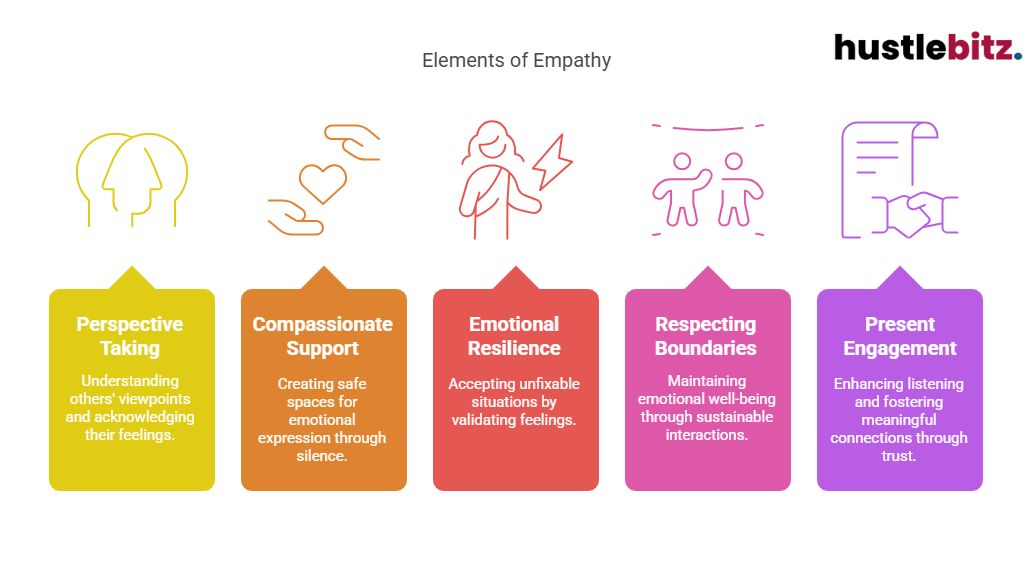
- Empathy involves perspective taking, acknowledging the validity of another’s feelings, and fostering genuine connections.
- Compassionate silence and supportive gestures create a safe space for emotional expression and understanding.
- Emotional resilience allows acceptance of unfixable situations through active listening and validation of feelings.
- Respecting personal boundaries is crucial for sustainable empathic interactions and maintaining emotional well-being.
- Present moment engagement enhances empathic listening and fosters meaningful connections built on trust and understanding.
“When we see that someone’s hurt or in pain, it’s our instinct as human beings to try to make things better. We want to fix, we want to give advice. But empathy isn’t about fixing. It’s the brave choice to be with someone in their darkness—not to race to turn on the light so we feel better.” —Brené Brown, Dare to Lead

When we observe someone in distress, our natural inclination is to alleviate their suffering by offering solutions or advice. However, empathy calls for a different approach, one less about fixing and more about emotional presence. It requires us to sit with someone in their darkness, resisting the urge to rush in with fixes to make ourselves feel better. This act of being present is a brave choice, demanding active listening and an openness to vulnerability sharing.
Active listening involves more than hearing words; it requires attention to the feelings and emotions behind those words. It is about offering compassionate silence, allowing the person in pain to express themselves without interruption. This silence is not empty; it is filled with understanding and respect, creating a safe space for others to explore and articulate their feelings.
Equally important are supportive gestures that communicate understanding without words. A gentle touch, a nod, or even a shared tear can convey empathy in profound ways that verbal communication often cannot achieve. These gestures, when genuine, can provide comfort and convey solidarity without overshadowing the individual’s pain with our urge to fix.
Vulnerability sharing can also be a powerful tool in empathy. By sharing our own experiences—carefully and appropriately—we help others see that they are not alone in their struggles. This mutual sharing fosters a connection that transcends mere advice-giving, strengthening bonds through shared human experience.
Thus, empathy is less about offering solutions and more about supporting others as they navigate their own journey through pain.
“Empathy isn’t about agreeing—okay? It’s just about putting on someone else’s shoes and walking a mile in them, and then understanding why they’re mad at us for stealing their shoes.”—Chuck Wendig, Damn Fine Story, p. 160-161

Empathy transcends mere agreement; it involves immersing oneself in another’s perspective to truly grasp their experiences and emotions. A common empathy misconception is that one must agree with someone else’s feelings to demonstrate understanding. However, empathy is about perspective taking—stepping into the emotional footwear of another and experiencing their journey without necessarily endorsing their feelings or actions.
Chuck Wendig’s metaphor of “stealing their shoes” underscores the complexity of relational dynamics and the nuanced dance of empathy. When we put on someone else’s “emotional footwear,” we gain insights into their world, which may include understanding anger that arises from situations we might not have encountered. This understanding does not imply agreement but an awareness of the factors contributing to their emotions.
Furthermore, empathy is about acknowledging the validity of another’s feelings, even when their perspectives differ from our own. It is crucial to navigate these relational dynamics with sensitivity and care, recognizing that people may feel vulnerable when sharing their experiences. Our role is to listen actively and provide a safe space for expression, rather than jumping to conclusions or judgments.
In practice, empathy requires a delicate balance between understanding and respect. By truly engaging in perspective taking, we can uncover the roots of anger and frustration in others, allowing us to respond with compassion and support. This approach fosters genuine human connection, offering an opportunity for healing and growth while maintaining the integrity of each individual’s unique experience.
Ultimately, empathy is about building bridges of understanding and paving the way for meaningful, supportive interactions.
“For what you can fix, there are a hundred remedies. For what cannot be cured, not even words will do.”—Alice Hoffman, The Rules of Magic, p. 250:

In the realm of human emotions and experiences, Alice Hoffman’s words from “The Rules of Magic” highlight a profound truth: not everything can be mended with action or comfort. This insight underscores the importance of distinguishing between what can be fixed and what requires acceptance. Emotional resilience becomes crucial in such moments, as it empowers individuals to navigate the emotional landscapes that lack tangible solutions.
When faced with situations beyond repair, emotional resilience serves as a guiding force, allowing individuals to maintain strength and empathy. Active listening is a vital component in supporting others through these challenging experiences. By attentively listening, we offer a space for shared experiences, validating emotions without the need for immediate solutions.
This practice acknowledges the complexity of human emotions and respects personal boundaries, ensuring that those we seek to serve feel heard and understood. Moreover, compassionate communication plays a pivotal role. While words may not cure, they can offer solace and foster a sense of connection.
Engaging in dialogues that prioritize empathy over solutions helps cultivate an environment where individuals feel safe to express their vulnerabilities. It is through this compassionate exchange that healing, albeit different from fixing, occurs.
Ultimately, Hoffman’s words remind us that some experiences are meant to be lived with rather than resolved. By embracing emotional resilience, practicing active listening, and engaging in compassionate communication, we can better serve others.
This approach honors the intricacies of human experiences, creating a supportive environment where individuals are empowered to confront the unfixable with grace and understanding.
“Having empathy doesn’t necessarily mean we’ll want to help someone in need, though it’s often a vital first step toward compassionate action.”—Greater Good Magazine, What is Empathy?
While Alice Hoffman’s insights on emotional resilience emphasize acceptance in the face of the unfixable, understanding empathy’s role in human interaction expands this discussion. Empathy dynamics play a crucial role in fostering a deeper connection with those around us.
Though empathy itself does not necessarily compel action, it lays the groundwork for overcoming emotional barriers and initiating compassionate responses. To effectively serve others, one must recognize that empathy is the bridge between awareness and action, facilitating personal growth and fostering meaningful relationships.
Empathy entails more than just understanding another’s emotions; it involves active listening and genuine engagement. This process enables us to identify with others’ experiences and emotions, which can lead to more informed and compassionate decisions.
However, empathy alone may not suffice to drive assistance or intervention. It’s the subsequent choices, informed by empathy, that define our capacity to truly support others.
Consider the following aspects of empathy dynamics:
- Active Listening: Engaging attentively in conversations to fully comprehend another’s perspective.
- Overcoming Emotional Barriers: Identifying and addressing internal biases that may hinder empathetic connections.
- Compassionate Responses: Transforming empathetic understanding into actionable support.
- Personal Growth: Leveraging empathy to enhance self-awareness and emotional intelligence.
- Relationship Building: Using empathy as a foundation to cultivate trust and mutual respect.
“To understand other people’s thoughts and feelings, we need to be fully involved in the present moment. Empathic accuracy is based on our moment-to-moment interactions—what is happening right now—as well as on our knowledge of another person’s personality, character, judgments, and opinion.”—Arthur Ciaramicoli and Katherine Ketcham, The Power of Empathy, p. 161
Fully engaging in the present moment is crucial to understanding others’ thoughts and feelings. This mindful presence allows for empathic accuracy, which requires not only being attentive but also understanding the relational dynamics at play. By focusing on moment-to-moment interactions, we enhance our emotional awareness, enabling us to discern subtle shifts in emotions and thoughts that might otherwise go unnoticed. Such awareness is fundamental for those committed to serving others, as it fosters genuine connections and trust.
Empathic listening involves more than just hearing words; it requires an openness to truly understand another person’s perspective. This active engagement helps us appreciate the nuances of their personality, character, judgments, and opinions. By doing so, we create a safe space where individuals feel valued and heard, which is essential in any service-oriented endeavor. It is through this deep understanding that we can respond with compassion and insight, ultimately leading to more meaningful interactions.
However, maintaining personal boundaries is equally important. While striving to connect, it is vital to preserve one’s own emotional well-being to sustain the ability to serve effectively. Recognizing and respecting these boundaries ensures that the process of empathic engagement does not become overwhelming or detrimental to oneself.
Balancing emotional awareness with personal boundaries allows for sustainable, authentic connections with others.
Final Thoughts
Empathy is a transformative force that deepens our understanding of others and strengthens human connections. It is not about offering solutions but about being fully present, listening, and allowing others to express their emotions without judgment. Empathy fosters compassion, acceptance, and emotional resilience, helping us navigate both the fixable and unfixable aspects of life. By embracing empathy, we create spaces where trust and understanding can flourish, building relationships that are supportive and grounded in genuine connection. In this way, empathy becomes the foundation for both personal growth and meaningful action.