

Achieving peak motivation through flow involves aligning your skills with appropriately challenging tasks. This balance reduces anxiety and boredom while boosting creativity and performance. Key strategies include self-reflection, periodic skill reassessment, and honest appraisal to understand your strengths and areas for improvement. Integrating mindfulness practices, clear goal-setting, and optimized environments can further facilitate entering a flow state. In both personal and professional settings, these techniques enhance intrinsic satisfaction and sustained engagement. You’ll discover methods to maintain this equilibrium and achieve superior outcomes by exploring further.
Key Takeaways
- Balancing skills and challenges is crucial for achieving flow and maintaining peak motivation.
- Regular self-reflection and feedback help accurately assess and align skills with appropriate challenge levels.
- Mindfulness practices and goal setting enhance present-moment focus and provide clear direction.
- Task variety and incremental progression prevent boredom and support continuous skill development.
- A positive environment and effective time management optimize flow experiences at work and in personal life.
The Science Behind Flow
From a neuroscience perspective, the flow state is marked by a harmonious neural pattern characterized by reduced activity in the prefrontal cortex, the brain region responsible for self-monitoring and conscious thought. This reduction facilitates a seamless integration of action and awareness, allowing individuals to perform tasks with greater precision and creativity.
Studies on the neuroscience of flow have shown that this state is accompanied by increased dopamine levels, which enhance feelings of pleasure and motivation.
The benefits of achieving a flow state are manifold. Individuals in flow tend to exhibit heightened creativity, as the unimpeded cognitive processes enable novel problem-solving and innovative thinking. This is particularly evident in artistic pursuits and sports, where athletes and performers often describe being “in the zone” – a term synonymous with optimal performance.
Flow in sports exemplifies how this state can lead to superior outcomes. Athletes immersed in flow report a heightened sense of control, reduced anxiety, and an effortless execution of skills. This psychological state not only enhances performance but also contributes to greater overall well-being.
Measuring flow experience involves assessing factors such as concentration, loss of self-consciousness, and the intrinsic enjoyment of the activity. These metrics help in identifying when individuals are in flow and understanding the conditions that facilitate this optimal state.
Identifying Your Skills
Understanding the neuroscience behind flow sets the stage for examining the practical steps required to achieve this optimal state. Identifying your skills is a fundamental step in this process. Effective skill assessment provides a clear picture of your personal strengths and areas that require development, which are essential for achieving flow.
To begin, self-reflection techniques can be employed to gain insight into your abilities. These techniques include journaling, self-assessment questionnaires, and reflective thinking exercises. Regularly engaging in self-reflection allows you to pinpoint what you excel at and where you might need further growth.
Another critical component is adopting a growth mindset. This involves viewing your skills as improvable through effort and practice, rather than as fixed traits. Embracing a growth mindset encourages continuous learning and resilience, both of which are crucial for maintaining motivation and achieving flow.
Feedback loops are also integral to identifying and honing your skills. Constructive feedback from mentors, peers, or supervisors provides external perspectives on your performance, helping you to recognize blind spots and validate your self-assessment. This feedback can be formal, such as performance reviews, or informal, such as casual advice from colleagues.
Lastly, it is important to regularly update your skill assessment. As you grow and develop, your strengths and weaknesses will evolve. Periodic reassessment ensures that you remain aware of your current capabilities and can adjust your goals and challenges accordingly.
Assessing Challenge Levels

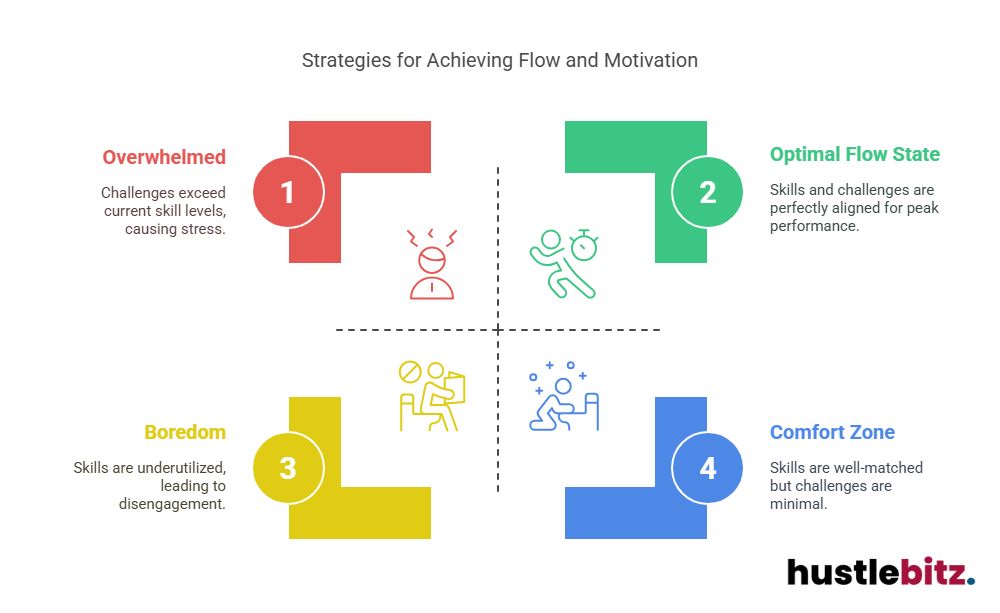
Accurately assessing challenge levels is crucial for achieving a state of flow, as it ensures that tasks are neither too easy nor overwhelmingly difficult. Understanding the delicate balance between challenge perception and skill development is key to sustaining motivation and performance. If challenges are perceived as too easy, boredom ensues; conversely, if they are too difficult, anxiety can derail progress. Therefore, a nuanced approach to evaluating challenge levels is essential.
Effective assessment begins with a clear understanding of one’s current skills and how they align with the demands of various tasks. This requires ongoing self-reflection and honest appraisal of one’s abilities. Incorporating task variety is another vital aspect, as it prevents monotony and stimulates different cognitive and physical skills, thereby maintaining engagement.
Consider the following strategies for assessing challenge levels:
- Feedback Mechanisms: Regular feedback from peers or mentors can provide an external perspective on whether challenges are appropriately matched to your skill set.
- Incremental Progression: Gradually increasing task difficulty allows for continuous skill development and helps in identifying motivation triggers that keep you engaged.
- Self-Assessment Tools: Utilizing self-assessment tools can help in objectively measuring your skill level and understanding where adjustments are needed to overcome obstacles.
Balancing Skills and Challenges

Evaluating challenge levels lays the groundwork for achieving flow, but the true art lies in balancing these challenges with your skills. This balance is essential for fostering flow experiences and ensuring sustainable performance enhancement. When challenges are too daunting relative to one’s skillset, stress and anxiety can arise, leading to diminished motivation. Conversely, if tasks are too simple, boredom ensues, stifling engagement and growth.
Skill development is paramount in maintaining this balance. By systematically increasing one’s capabilities, an individual can tackle more complex challenges without feeling overwhelmed. This ongoing enhancement of skills not only prepares individuals for greater tasks but also keeps them engaged and motivated. Regularly seeking feedback, engaging in deliberate practice, and setting incremental goals are effective strategies for skill development, ensuring continuous improvement and readiness for evolving challenges.
Challenge adaptation is another critical aspect. As skills grow, the nature of challenges must evolve to prevent stagnation. Adapting challenges to match current abilities keeps the individual in the optimal zone for flow, where tasks are neither too easy nor excessively difficult. This adaptation can involve increasing task complexity, introducing new elements, or setting higher performance standards.
Motivation strategies play a crucial role in maintaining the balance between skills and challenges. Intrinsic motivation, driven by personal satisfaction and interest in the task, is particularly powerful for sustaining engagement.
Extrinsic motivators, such as rewards and recognition, can complement intrinsic drivers, providing additional incentives for performance enhancement.
Techniques to Enter Flow

Achieving a state of flow requires deliberate techniques that facilitate the seamless merging of action and awareness. To enter this optimal state, one must cultivate specific conditions both internally and externally. By leveraging mindfulness practices, setting clear goals, optimizing environmental factors, managing time effectively, and incorporating feedback loops, individuals can significantly enhance their ability to experience flow.
Mindfulness practices are essential for fostering a mental state conducive to flow. Techniques such as meditation and focused breathing can help practitioners maintain present-moment awareness, thereby reducing distractions and enhancing concentration. This heightened level of focus is crucial for engaging deeply with tasks.
Goal setting is another pivotal technique. Establishing clear and achievable objectives provides direction and purpose, which are vital for maintaining motivation. When goals are well-defined, individuals can channel their efforts more effectively, aligning their skills with the challenges at hand.
Environmental factors also play a significant role in facilitating flow. Creating a workspace that minimizes interruptions and promotes focus can dramatically improve one’s ability to concentrate. Factors such as lighting, noise levels, and ergonomic design all contribute to an environment conducive to flow.
To sum up, several techniques can aid in achieving flow:
- Mindfulness practices: Utilizing meditation and focused breathing to maintain present-moment awareness.
- Goal setting: Establishing clear, achievable objectives to provide direction and purpose.
- Environmental factors: Optimizing the workspace to minimize distractions and promote focus.
Additionally, effective time management ensures that tasks are approached with sufficient time and energy, while feedback loops provide critical information for continuous improvement. By integrating these techniques, individuals can enhance their capacity to achieve and sustain a state of flow.
Flow in the Workplace

In the bustling environment of the modern workplace, achieving a state of flow can significantly enhance productivity and job satisfaction. Flow, a state where individuals are fully immersed and engaged in their tasks, is not only beneficial for personal achievement but also for overall organizational success.
Key elements such as team collaboration, workplace environment, leadership influence, feedback culture, and task variety play crucial roles in fostering this optimal state.
Team collaboration is essential for sustaining flow, as it encourages the seamless exchange of ideas and support among colleagues. When team members work cohesively, they can better align their skills and challenges, thereby facilitating a flow state.
A positive workplace environment, characterized by mutual respect and open communication, further contributes to this synergy. It is important for leadership to recognize their influence in creating such an environment. Effective leaders set clear goals, provide resources, and cultivate a culture that values continuous improvement and innovation.
The feedback culture within an organization is another critical factor. Constructive feedback helps employees to understand their strengths and areas for improvement, allowing them to adjust their approach and maintain flow.
Regular, specific, and timely feedback fosters a growth mindset, which is essential for sustaining motivation and engagement.
Task variety is also paramount in preventing monotony and burnout. When employees are presented with a diverse range of tasks that challenge their abilities, they are more likely to remain engaged and in flow.
Balancing routine tasks with those that present new challenges can keep the workforce dynamic and motivated.
Flow in Personal Life

Cultivating a state of flow in personal life can lead to profound improvements in well-being, satisfaction, and overall happiness. Achieving flow outside of professional settings involves activities that align closely with one’s interests and capabilities, providing a sense of purpose and fulfillment. This can be achieved through various avenues that cater to personal growth, deeper relationship dynamics, and creative expression.
One effective method to foster flow in personal life is through hobby exploration. Engaging in activities that challenge and interest you, whether it’s painting, playing a musical instrument, or gardening, can create immersive experiences that promote a state of flow. These hobbies not only offer a break from daily routines but also serve as a platform for personal growth and self-discovery.
Mindfulness practices are another critical aspect. Practicing mindfulness can enhance one’s ability to remain present and fully engaged in the moment, which is a key component of achieving flow. Techniques such as meditation, yoga, or even mindful walking can help calm the mind and focus attention, thereby facilitating a smoother transition into flow states.
Lastly, nurturing relationship dynamics can significantly contribute to one’s flow experiences. Engaging in meaningful conversations, collaborative activities, or shared interests with friends and family can create harmonious interactions that foster flow. This not only strengthens bonds but also enriches personal life with shared joy and satisfaction.
- Hobby exploration: Dive into activities that challenge and interest you.
- Mindfulness practices: Utilize techniques to enhance present-moment awareness.
- Relationship dynamics: Engage in meaningful and collaborative interactions.
Incorporating these elements into daily life can lead to a richer, more fulfilling existence, where flow becomes a natural part of personal experiences.
Final Thoughts
Achieving flow is a powerful way to boost motivation, creativity, and overall satisfaction, both in professional and personal settings. By aligning your skills with appropriately challenging tasks, practicing mindfulness, setting clear goals, and optimizing your environment, you can create conditions conducive to flow. Regular self-assessment, feedback, and task variety ensure continuous growth and engagement. Whether at work or in your personal life, fostering flow can lead to deeper fulfillment and peak performance. Embrace these strategies to cultivate a balanced, motivated approach to life’s challenges and opportunities.