

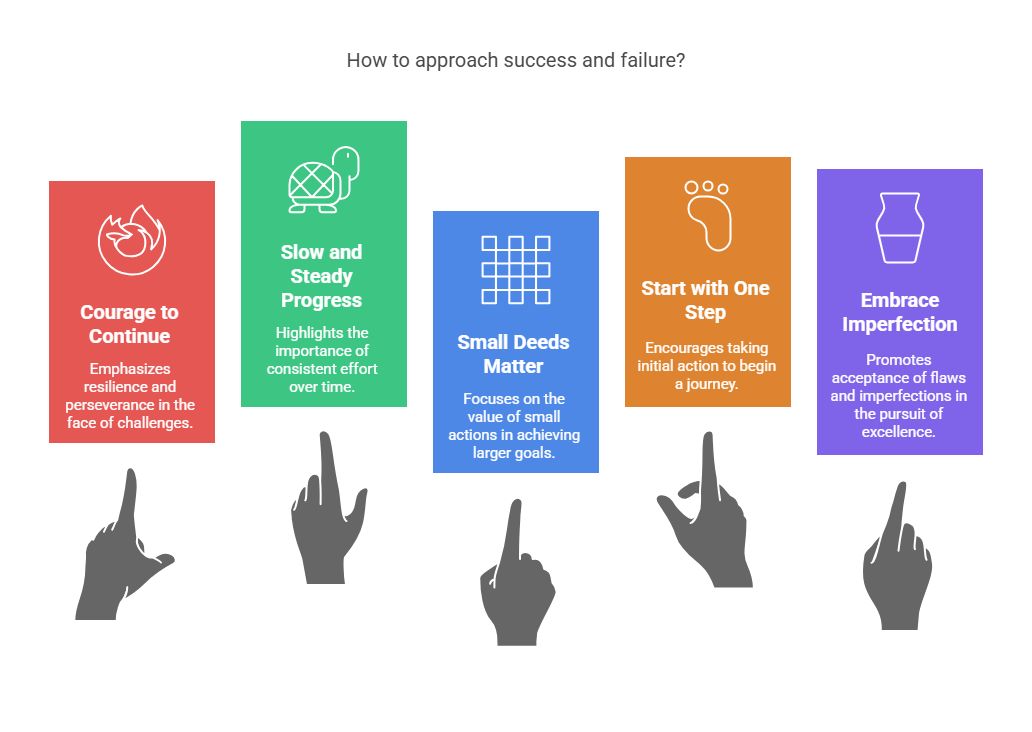
Overcoming perfectionism involves shifting focus from an unattainable ideal to celebrating progress and personal growth. Winston Churchill emphasized resilience, noting that courage through setbacks is crucial. Confucius highlighted the value of consistent effort, regardless of speed, to foster growth. Peter Marshall advocated the significance of small accomplishments over grand intentions, reinforcing that incremental achievements fuel progress. Salvador Dalí succinctly captured the futility of pursuing perfection, encouraging individuals to embrace the journey of self-discovery. Richard Branson’s perspective on learning from failures underscores the importance of growth and continuous improvement. By exploring these insights, one uncovers a path toward a more fulfilling narrative of success.
Key Takeaways
- “Success is not final, failure is not fatal: It is the courage to continue that counts.” – Winston Churchill.
- “It does not matter how slowly you go as long as you do not stop.” – Confucius.
- “Small deeds done are better than great deeds planned.” – Peter Marshall.
- “The journey of a thousand miles begins with one step.” – Lao Tzu.
- “Have no fear of perfection—you’ll never reach it.” – Salvador Dalí.
Defining Perfectionism

Perfectionism, a psychological construct often misunderstood, is characterized by the relentless pursuit of flawlessness and an overly critical self-evaluation. This definition encapsulates a mindset where individuals set unattainably high standards for themselves, which can lead to a cycle of dissatisfaction and stress.
The psychological impact of perfectionism is profound, often manifesting as anxiety, depression, and a decreased sense of well-being. Those afflicted may experience a constant fear of failure, which stifles creativity and impedes personal growth.
Societal pressures significantly contribute to the prevalence of perfectionism. In an era dominated by social media and constant comparison, individuals may feel compelled to present a curated, perfect version of themselves. This societal expectation not only exacerbates feelings of inadequacy but also reinforces the notion that one’s worth is contingent upon external validation.
Consequently, perfectionism can become a barrier to authentic self-expression and fulfillment.
Personal experiences further shape the trajectory of perfectionist tendencies. For some, early life experiences, such as receiving conditional approval based on achievements, can instill a belief that perfection is necessary for acceptance and love.
Overcoming these barriers requires a shift in mindset—a conscious decision to embrace imperfection and prioritize progress over unattainable ideals.
Understanding the perfectionism definition and its psychological impact is crucial for those seeking to break free from its confines. By acknowledging the societal and personal influences that perpetuate this mindset, individuals can begin to dismantle the barriers that hinder their potential, fostering a healthier, more balanced approach to life.
The Cost of Perfection

The quest for perfection often comes at a significant cost, as articulated in various quotes that shed light on its detrimental effects. These insights serve as reminders of how relentlessly striving for flawlessness can undermine our well-being, relationships, and efficiency.
Perfectionism costs can manifest in numerous ways, from an emotional toll to a productivity drain, impacting both personal and professional spheres.
One poignant quote suggests that “Perfectionism is the voice of the oppressor, the enemy of the people. It will keep you cramped and insane your whole life.” This highlights the emotional toll that perfectionism can exact, leading to a constant state of dissatisfaction and self-criticism that undermines mental health.
A second quote states, “The man with the perfect plan is often too late,” emphasizing the productivity drain that arises when individuals become paralyzed by an endless pursuit of the perfect strategy rather than taking action.
Another insightful quote, “The cost of perfection is relationships,” underscores the impact on personal relationships, as those consumed by perfectionism may become isolated, unable to connect authentically with others due to unrealistic expectations.
Finally, a wise saying reminds us, “Perfectionism is not a quest for the best. It is a pursuit of the worst in ourselves.” This quote encapsulates the paradox of perfectionism, where the aim for the best often results in amplifying our flaws, affecting mental health and self-esteem.
- Emotional Toll: Constant dissatisfaction and self-criticism.
- Productivity Drain: Paralysis by overplanning.
- Personal Relationships: Strain and isolation.
- Mental Health: Amplified anxiety and stress.
These reflections reveal the true cost of an unwavering commitment to perfection, encouraging a shift towards embracing progress over unattainable ideals.
Embrace Imperfection
Recognizing the beauty in imperfection allows individuals to experience life more fully and authentically. This perspective encourages a self-acceptance journey where personal growth is prioritized over unattainable ideals. Embracing imperfection is not merely an act of resignation but a celebration of the uniqueness that defines each person, fostering a deeper connection with oneself and others.
One compelling quote on this topic is from Leonard Cohen: “There is a crack in everything, that’s how the light gets in.” This metaphorical acknowledgment of flaws as pathways for growth reinforces the idea that learning experiences are often born from imperfections. It suggests that authenticity matters more than the superficial facade of perfection.
Brené Brown, a well-respected researcher on vulnerability, offers another insightful perspective: “Imperfections are not inadequacies; they are reminders that we’re all in this together.” This quote underscores the shared human experience, emphasizing that embracing our flaws cultivates empathy and connection, essential components of personal growth.
Similarly, the Japanese concept of “wabi-sabi,” which finds beauty in the imperfect, reminds us to celebrate the transient and incomplete. This philosophy encourages a shift from perfectionism to appreciating life’s fleeting moments and the lessons they impart.
Furthermore, author Elizabeth Gilbert reminds us, “Perfectionism is just a high-end, haute couture version of fear.” Her words prompt reflection on how fear can stifle creativity and hinder progress, urging us to courageously embrace our imperfect selves.
Ultimately, these quotes invite us to recognize that embracing imperfection is integral to a fulfilling and authentic life journey.
Growth Over Perfection
Moving from the celebration of imperfection to the pursuit of growth presents a valuable shift in perspective. This journey encourages us to focus on the dynamics of personal development rather than the static notion of perfection.
Growth over perfection emphasizes the importance of a self acceptance journey, where individuals embrace their unique paths and experiences. This approach promotes mindful growth, fostering environments that nurture intentional living and resilience building, creating a more meaningful existence.
Consider these top five quotes that encapsulate the essence of choosing growth over perfection:
- “The only person you are destined to become is the person you decide to be.” This quote highlights the proactive nature of personal development, urging individuals to take control of their self acceptance journey.
- “Growth is never by mere chance; it is the result of forces working together.” Here, the emphasis is on mindful growth, recognizing that progress is often a collaborative effort involving various aspects of life.
- “Life isn’t about finding yourself. Life is about creating yourself.” This perspective encourages intentional living, where individuals craft their own paths rather than seeking predefined ideals.
- “Strength and growth come only through continuous effort and struggle.” This statement underscores resilience building, acknowledging that true growth often arises from overcoming challenges.
These quotes inspire a redefinition of success as a continuous journey rather than a finite destination.
Embracing Progress

Embracing progress involves a conscious commitment to continuous improvement, valuing each step taken towards achieving goals. This mindset, often described as a “progress mindset,” encourages individuals to focus on the journey of self-acceptance rather than the unattainable ideal of perfection. By celebrating small wins, one learns to appreciate the value of incremental achievements, which is crucial in overcoming self-doubt and fostering mindful growth.
The following quotes encapsulate the essence of embracing progress:
| Quote | Author | Key Concept |
| “Success is not final, failure is not fatal: It is the courage to continue that counts.” | Winston Churchill | Progress Mindset |
| “It does not matter how slowly you go as long as you do not stop.” | Confucius | Mindful Growth |
| “Small deeds done are better than great deeds planned.” | Peter Marshall | Celebrating Small Wins |
| “The journey of a thousand miles begins with one step.” | Lao Tzu | Self Acceptance Journey |
| “Do not be embarrassed by your failures, learn from them and start again.” | Richard Branson | Overcoming Self Doubt |
These quotes remind us that progress is a journey marked by perseverance and learning. Churchill emphasizes the courage to continue, highlighting the importance of resilience. Confucius and Lao Tzu stress the significance of persistence and initiating action, respectively. Marshall’s words encourage us to act, even if the actions appear small, while Branson’s perspective helps us see failures as stepping stones rather than roadblocks.
In embracing progress, each step is a testament to growth, reflection, and the unwavering pursuit of personal excellence. By internalizing these lessons, one can navigate the self-acceptance journey with confidence and grace.
Letting Go of Flawlessness

As one learns to embrace progress, it becomes equally important to acknowledge the necessity of letting go of the pursuit of flawlessness. This shift in perspective allows individuals to embark on a self acceptance journey, encouraging a more profound connection with one’s authentic self.
The following quotes illuminate the path toward mindful living, where embracing vulnerability becomes an asset rather than a liability. In overcoming fear, these insights remind us that the relentless chase for perfection often obscures the beauty of genuine human experience.
- “Have no fear of perfection—you’ll never reach it.” – Salvador Dalí. This quote encapsulates the futility of chasing perfection, urging us to recognize the unattainable nature of flawlessness and instead focus on growth and self-discovery.
- “Perfection is the enemy of progress.” – Winston Churchill. By acknowledging that perfection hinders advancement, we learn to value steady progress, which fosters resilience and adaptability in our self acceptance journey.
- “There is no perfection, only beautiful versions of brokenness.” – Shannon L. Alder. Embracing our imperfections allows us to see beauty in our vulnerabilities, promoting a deeper understanding of our authentic selves.
- “The thing that is really hard, and really amazing, is giving up on being perfect and beginning the work of becoming yourself.” – Anna Quindlen. This quote emphasizes the transformative power of letting go, enabling individuals to live mindfully and authentically.
Creativity and Imperfection

The intersection of creativity and imperfection reveals a landscape where innovation thrives. In the realm of creative expression, embracing flaws is not merely an acceptance but a strategic advantage. The imperfect beauty found in creative works often stems from the artist’s courage to diverge from conventional paths.
It is within this divergence that artistic freedom flourishes, allowing creators to explore uncharted territories and uncover new possibilities.
One compelling quote on this subject is from Leonard Cohen: “There is a crack in everything, that’s how the light gets in.” This metaphorical crack represents the imperfections that, instead of diminishing value, enhance the authenticity in creation. It is through acknowledging and celebrating these flaws that artists can achieve deeper connections with their audience.
Similarly, the words of Salvador Dalí, “Have no fear of perfection – you’ll never reach it,” underscore that innovation through flaws is inherent in the creative process. By relinquishing the pursuit of perfection, artists liberate themselves to experiment, leading to groundbreaking discoveries.
Another insightful perspective comes from Elizabeth Gilbert, who states, “Perfectionism is just fear in fancy shoes and a mink coat.” This quote highlights the necessity of overcoming perfectionism to truly embrace the creative process and its inherent unpredictability.
In the words of author Anne Lamott, “Perfectionism is the voice of the oppressor.” Her statement serves as a reminder that creativity must be freed from the shackles of perfection to allow authentic and innovative expression to emerge.
These quotes collectively champion the idea that creativity, when intertwined with imperfection, fosters genuine artistic achievement.
Final Thoughts
Overcoming perfectionism requires a shift in mindset from unattainable ideals to embracing progress and growth. By focusing on personal development, accepting imperfections, and celebrating small wins, we create a more fulfilling and authentic journey. The quotes from Churchill, Dalí, Curie, and others serve as reminders that growth comes from courage, resilience, and the ability to see value in our imperfections. Letting go of the need for flawlessness opens the door to creativity, innovation, and a more compassionate relationship with ourselves. Remember, it’s not about being perfect—it’s about making progress and finding joy in every step of the way.